To Wear or to Preserve: The Collector's Dilemma at the Heart of Luxury Ownership
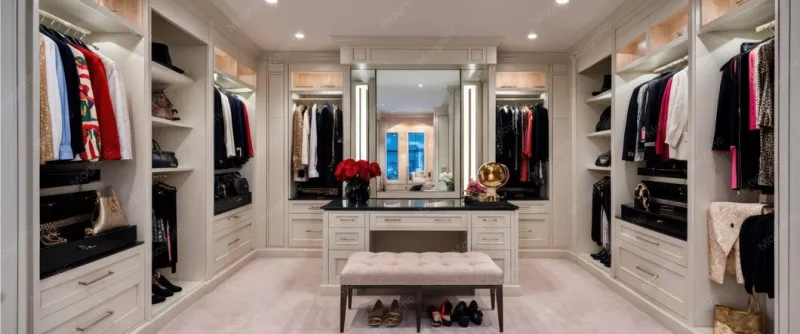
Photo: luxury fashion archive closet preservation climate controlled wardrobe, via img.freepik.com
There is a particular kind of stillness that settles over a well-appointed dressing room when its owner pauses before a garment they have spent years—and considerable resources—acquiring. It is not indecision, exactly. It is something closer to reverence. And increasingly, among the most thoughtful collectors in the United States, that reverence is giving way to a question that no amount of wealth can answer simply: Is this piece meant to be worn, or meant to be kept?
This is the archive paradox. It lives at the intersection of passion and pragmatism, of beauty and preservation, and it is reshaping the way America's most discerning individuals relate to the objects they collect with such care.
The Psychology of Ownership at the Highest Level
Luxury ownership has always carried an emotional dimension that transcends the transactional. When a collector acquires a bias-cut silk gown from the late estate of a celebrated designer, or tracks down a numbered handbag from a discontinued atelier run, they are not simply purchasing an object. They are entering into a relationship—one defined by responsibility as much as pleasure.
Psychologists who study material culture suggest that high-value possessions often trigger what they call the "museum effect": the instinct to protect something beautiful by placing it beyond reach. The collector begins to treat the object as a specimen rather than a tool, admiring it from a careful distance. For some, this instinct is entirely appropriate. For others, it quietly erodes the very joy that motivated the acquisition in the first place.
The tension, as many collectors have discovered, is not simply between use and preservation. It is between two competing visions of what a luxury piece is for.
What Museum Conservators Know That Most Collectors Don't
Textile conservation professionals—the specialists who maintain the costume collections at institutions such as the Metropolitan Museum of Art and the Museum of Fine Arts in Boston—operate according to principles that private collectors are only beginning to adopt. Their guidance is instructive, even if the scale differs considerably.
Light, temperature, humidity, and handling are the four primary agents of textile deterioration. Ultraviolet exposure fades dyes and weakens fibers at a molecular level; fluctuating humidity causes organic materials to expand and contract in ways that eventually compromise their structural integrity. Even the oils naturally present on human hands can accelerate the degradation of delicate silk, fine leather, and hand-embroidered textiles over time.
Conservators advocate for what they term "passive preservation": storing garments in acid-free tissue, hanging structured pieces on appropriately padded forms, and maintaining storage environments at consistent temperatures between 60 and 70 degrees Fahrenheit with relative humidity held between 45 and 55 percent. These are not eccentric standards. They are the difference between a piece that endures for generations and one that quietly deteriorates behind a wardrobe door.
For private collectors, the practical implication is clear: how a piece is stored matters as much as how it was acquired.
The Rise of the Private Collector's Conservation Suite
Across the country, a quiet industry has emerged to serve collectors who take their archives seriously. Climate-controlled storage facilities—once the exclusive province of museums, auction houses, and commercial galleries—now offer private vault services tailored specifically to fashion and textile collections. Companies operating in cities such as New York, Los Angeles, and Chicago provide individually monitored storage units equipped with HEPA filtration, UV-blocking enclosures, and real-time humidity tracking accessible via digital dashboards.
Beyond storage, bespoke textile conservation services have extended their clientele well beyond institutional clients. Private conservators now offer in-home assessments, custom archival housing, and restoration consultations for collectors whose wardrobes include pieces of genuine historical or monetary significance. Some of the most sought-after specialists maintain waiting lists measured in months.
For the collector who wishes to engage with their archive more actively, wearable conservation has also gained traction. This approach involves having a conservator assess a piece before it is worn—identifying vulnerabilities, recommending protective undergarments to minimize contact, and advising on appropriate occasions and environments. It is, in essence, a risk-management strategy for the wardrobe.
Wearing as an Act of Stewardship
Not every collector resolves the paradox in favor of preservation. A growing school of thought among luxury connoisseurs holds that wearing a piece—carefully, thoughtfully, on occasions that honor its origins—is itself a form of stewardship. A couture gown that exists only in a box, however acid-free, is a gown denied its essential purpose. Craft, by this reasoning, is meant to be inhabited.
This perspective finds support in the philosophy of several notable designers and artisans, who have expressed, in interviews and correspondence, a preference that their work be worn rather than archived. The garment, in their view, completes itself through use. Its relationship with a human body is not incidental to its meaning—it is central to it.
For collectors who share this sensibility, the answer lies not in choosing between wearing and preserving, but in wearing with the consciousness of a curator. Every outing becomes an occasion considered in advance: Is the environment appropriate? Is the event proportionate to the piece? What care will it require afterward?
Building a Personal Archive with Intention
At Secret Collection, we have long believed that the most meaningful wardrobes are not the largest ones. They are the most considered. The archive paradox, at its heart, is an invitation to that consideration—to examine not only what one owns, but why, and what one hopes those pieces will mean in ten, twenty, or fifty years.
The collectors who navigate this tension most gracefully tend to share a common trait: they have made peace with the idea that a wardrobe can be both a living practice and a legacy simultaneously. Some pieces are worn. Some pieces are kept. The wisdom lies in knowing which is which—and in having the infrastructure, both physical and philosophical, to honor that distinction.
For those beginning to think of their wardrobes as archives, the first step is neither the most expensive nor the most complicated. It is simply the most intentional: to look at what you own, to understand what it represents, and to decide, with full awareness, what relationship you wish to have with it.
That decision, made deliberately, is itself an act of luxury.