The Story Behind the Stitch: Why Origin and Authorship Have Become Luxury's New Currency
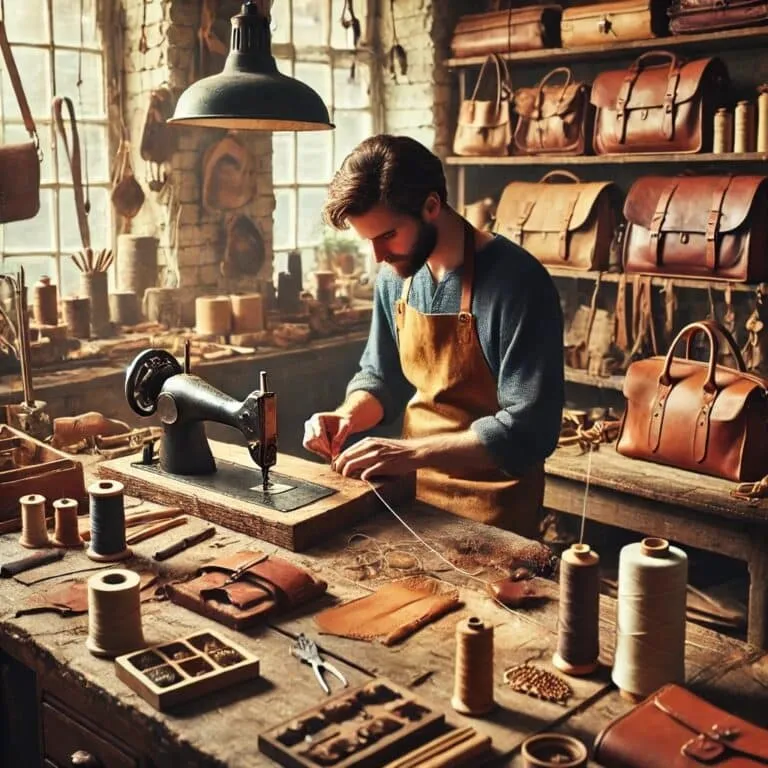
Photo: luxury artisan atelier craftsman leather goods provenance documentation, via blog.florenceleathermarket.com
Not long ago, the most legible signal of luxury was also the most visible: a monogram repeated across a canvas surface, a nameplate affixed to a clasp, a logo embossed into leather with the confidence of an institution that needed no further introduction. Status was worn on the outside, and it communicated itself in a single glance.
That era has not ended—but it has been complicated, significantly, by a cohort of buyers for whom visibility was never the point. Among the most discerning collectors operating in the American luxury market today, the conversation has shifted from what is it? to where does it come from? And that shift is quietly reordering the economics of the entire industry.
Provenance as the New Prestige
The concept of provenance—the documented history of an object's origin, ownership, and journey through time—has long governed the markets for fine art, rare wine, and antique furniture. A painting's value is inseparable from its chain of custody; a bottle of Burgundy commands its price in part because its vineyard, vintage, and cellar conditions are verifiable and specific. The object and its story are not distinct. They are the same thing.
Luxury fashion is arriving at a similar understanding, albeit through a different route. The catalyst has been a convergence of factors: a generation of consumers with sophisticated skepticism about corporate narratives, a broader cultural reckoning with supply chain ethics, and a growing recognition—among buyers at the very top of the market—that genuine rarity is defined not by price alone, but by irreproducible specificity.
A handbag produced by an anonymous factory in an undisclosed location, regardless of the name on its hardware, cannot tell you who shaped its gussets or who selected its hide. A bag made by a named artisan in a documented atelier, using leather from a specific tannery with a three-generation history, can. The second object carries something the first cannot replicate: a verifiable human presence within the thing itself.
The Blockchain Moment in Fashion Authentication
Technology has accelerated this appetite for transparency in ways that would have seemed implausible a decade ago. Blockchain-based authentication platforms—initially developed to combat the counterfeit goods market—have evolved into something considerably more nuanced: tools for telling the complete story of a luxury object from raw material to finished form.
Several European heritage houses and a growing number of independent American designers have begun embedding digital records into their pieces at the point of creation. A near-field communication chip sewn discreetly into a lining or embedded in a leather tag can, when scanned, return a complete provenance record: the origin of the wool, the name of the weaver, the date the piece entered its final construction phase, and the number of hands that shaped it along the way.
For collectors, this is not a novelty. It is a revelation. The ability to access a garment's complete biography—not as marketing copy, but as verifiable, immutable record—transforms the act of purchase into something approaching scholarship. One acquires not merely an object but a documented artifact.
Direct Relationships and the Collector-Designer Compact
Beyond technology, a more personal form of provenance is emerging among the most dedicated luxury consumers: the direct relationship between collector and maker. In the rarefied space where fashion intersects with patronage, a number of designers and independent artisans now work exclusively with a small circle of established clients—people who commission pieces with full knowledge of every creative and material decision involved.
These arrangements bear little resemblance to the standard retail transaction. They are closer, in spirit and in structure, to the historic relationship between a couture house and its clientes—built on ongoing dialogue, mutual trust, and a shared investment in the work itself. The collector participates in the object's creation not by directing its design, necessarily, but by being present to its story from the outset.
This model has found particular resonance among American collectors who have grown weary of what might be called the "anonymous luxury" of mass-produced high-end goods. The desire is not simply to own something expensive. It is to own something known—something whose origins are as clear and as considered as the craftsmanship itself.
Transparency as a Premium Offering
For brands and boutiques serving this market, the implications are significant. Transparency is no longer a compliance posture or a marketing strategy. It is a product feature—one that commands a genuine premium among buyers who have the resources and the inclination to demand it.
Retailers who can speak with authority about the production lineage of the pieces they carry—who can name the mill that produced a fabric, describe the tanning process used on a hide, or introduce a client to the artisan responsible for a particular technique—occupy a fundamentally different position in the market than those who cannot. Knowledge, in this context, is inventory.
At Secret Collection, curation has always meant more than aesthetic selection. It means understanding the full biography of the objects we present, and being prepared to share that knowledge with clients who regard it as integral to the value of what they acquire. The story behind a piece is not supplementary to the piece. In many cases, it is the piece.
The Collector's Responsibility
There is, of course, a certain discipline required of the collector who takes provenance seriously. It demands patience—the willingness to forgo an immediately available object in favor of one whose origins can be properly established. It demands inquiry—the habit of asking questions that many retailers are not yet accustomed to answering. And it demands a degree of intellectual engagement with the history of craft, materials, and production that goes well beyond what most consumer relationships require.
But for those who have developed this habit of mind, the rewards are considerable. A wardrobe built on documented provenance is not simply a collection of beautiful objects. It is a record of considered decisions, of relationships with makers, and of a sensibility refined over time. It carries the kind of meaning that no logo, however prestigious, can confer.
That, ultimately, is the distinction that the most sophisticated collectors are drawing: between the luxury of recognition and the luxury of knowledge. The former can be purchased. The latter must be cultivated.
And it is, by any measure, the rarer of the two.