Rooted in Craft: The American Artisans Redefining Domestic Luxury for the Discerning Collector
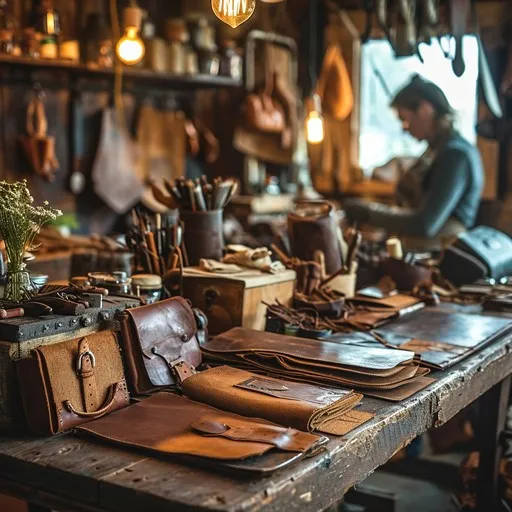
Photo: American artisan craftsman leather workshop handmade luxury goods studio, via images.stockcake.com
The story of American luxury has long been told in borrowed accents. For much of the twentieth century, the aspirational vocabulary of fine dressing pointed resolutely toward Europe—toward the ateliers of Paris, the tailoring traditions of London, the leather workshops of Florence. To wear something truly exceptional, the prevailing assumption held, was to wear something that had crossed an ocean to reach you.
That assumption deserves to be challenged. Not out of nationalism, but out of genuine curiosity—the same curiosity that leads a serious collector to look beyond the obvious, to seek out the overlooked, and to find beauty in places the broader market has not yet discovered. Because across the United States, from the tanneries of New England to the weaving studios of the rural Southwest, a cohort of artisans is producing work of extraordinary quality: goods that carry authentic stories, rare technical skill, and the kind of provenance that cannot be fabricated.
For the discerning collector, this is not a compromise. It is an opportunity.
The Meaning Behind the Made-in-America Label
It is worth being precise about what we mean when we speak of American-made luxury, because the phrase is frequently invoked and rarely examined. We are not referring to mass-produced goods that happen to be assembled domestically, nor to heritage branding applied to products manufactured at industrial scale. We are speaking of something far more specific: objects made by hand, in limited quantities, by craftspeople who have devoted years—often decades—to mastering a single discipline.
This distinction matters enormously to the collectors who seek these pieces out. What draws them is not the geography of origin, but what that geography represents: an unbroken line between maker and material, between intention and object. When a saddler in Colorado hand-stitches a leather portfolio using hides tanned through a traditional vegetable process, or when a fourth-generation weaver in North Carolina produces a limited run of hand-loomed wool throws on a loom her grandmother once operated, the resulting piece carries a weight of meaning that mass production structurally cannot replicate.
"My clients have access to everything," says one Chicago-based luxury retail consultant who specializes in sourcing for private collectors. "What they're looking for now is not rarity in the commercial sense—it's rarity in the human sense. They want to know that someone cared deeply about what they made."
Where the Collectors Are Looking
The geography of American artisan luxury is surprisingly varied, and the most rewarding discoveries often require a degree of research that the casual shopper is unlikely to undertake. This, of course, is precisely what makes the finds so satisfying.
Leatherwork and saddlery traditions of the American West have produced a small but remarkable group of contemporary makers working in the custom boot and bespoke leather goods space. Several studios in Texas and Montana maintain waiting lists measured in months, producing hand-tooled belts, bags, and travel accessories that improve demonstrably with age—a quality that distinguishes them sharply from fashion-forward luxury goods engineered for seasonal replacement.
Textile traditions in the American Southeast, particularly in the Appalachian region, represent another area of quiet excellence. A number of small studios and family operations continue to produce hand-loomed textiles using domestic wool and natural dyes, creating limited-run pieces of exceptional tactile quality. These goods rarely appear in conventional retail channels; they are most often discovered through direct relationships with the makers or through curators who have taken the time to build those connections.
Bespoke tailoring in American cities—New York, Chicago, and San Francisco in particular—has experienced a genuine resurgence, with a new generation of tailors trained in traditional British and Italian techniques now applying those methods to American clients and American contexts. The resulting garments are neither imitations nor compromises; they are works of sartorial intelligence that reflect the specific posture, lifestyle, and aesthetic sensibility of the individual wearer.
The Investment Case for Domestic Artisan Luxury
Beyond the aesthetic and ethical dimensions of supporting American craftspeople, there is a practical argument for the collector who thinks in terms of long-term value. Pieces produced in genuine limited quantities by skilled artisans with established reputations have historically held their value—and in some cases appreciated—in ways that trend-driven luxury goods do not.
This is particularly true of goods made from premium domestic materials: full-grain leathers, heritage breed wools, and hand-forged metals that are increasingly difficult to source at the quality levels that serious makers demand. As the supply of truly exceptional raw materials contracts, objects made from them become inherently more significant.
There is also the matter of the maker's story—a dimension of value that is becoming increasingly important to sophisticated collectors. An object with a traceable, compelling provenance is not simply a beautiful possession; it is a piece of living cultural history. That narrative has value that compounds over time in ways that a well-marketed but generically produced luxury item simply cannot match.
Sourcing with Intention
Discovering the finest American artisan makers requires a different approach than conventional luxury retail. These craftspeople rarely advertise aggressively, and their work seldom appears on the floor of a department store or in the pages of a mass-circulation fashion publication. They are found through referrals, through regional craft organizations, through the recommendations of trusted curators, and occasionally through the kind of patient, unhurried exploration that the best collecting always demands.
At Secret Collection, our commitment to curating work of genuine distinction extends naturally to the domestic artisan space. We believe that the most meaningful additions to a collector's life are those that carry both beauty and story—and that the finest American makers offer both in abundance.
The European houses will always have their place. But the collector who has never looked closely at what is being made on American soil is missing a chapter of the luxury story that is, in many ways, just beginning to be told.