Gifted and Burdened: The Complex Truth About Passing Down a Curated Wardrobe
There is a particular kind of pride that accompanies a well-built collection. Every piece chosen with patience, every acquisition weighed against a standard refined over years — perhaps decades. For the serious collector, the wardrobe is not merely clothing. It is biography. It is taste made tangible. And so, when the question of inheritance arises, it arrives wrapped in an assumption that rarely goes examined: that the heir will feel precisely what the collector feels when confronted with these objects.
They may not. And that tension — between legacy offered and legacy received — is one of the more quietly complicated conversations in luxury today.
The Weight of Someone Else's Vision
Eleanor Marsh, a Chicago-based estate attorney who has spent twenty years navigating the transfer of high-value personal property, has witnessed this dynamic more times than she can count. "Clients come to me having spent extraordinary care building wardrobes with genuine monetary and cultural value," she explains. "But they've rarely asked their children what they actually want to do with any of it."
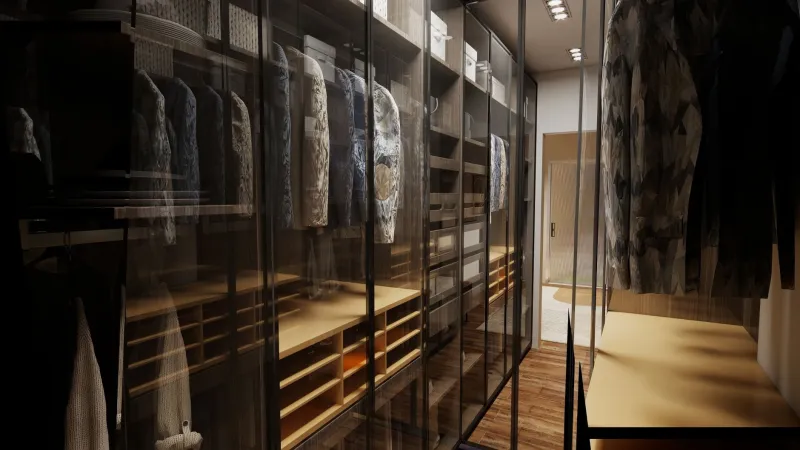
The oversight is understandable. Collectors are, by nature, absorbed in the logic of their own aesthetic. The internal grammar of a great collection — the way a particular Hermès piece speaks to a vintage American sportswear find, the reason a certain silhouette recurs across three different decades — is legible primarily to the person who assembled it. For the heir standing at the threshold of a climate-controlled archive, that grammar can feel less like an inheritance and more like a test they never agreed to take.
Fashion historian Dr. Patricia Soo, whose research at Columbia University focuses on the cultural transmission of material goods, frames it succinctly: "Inherited objects carry the emotional fingerprints of the previous owner. Luxury objects carry those fingerprints at an amplified frequency. The more significant the piece, the more it arrives with expectation already embedded in the fabric."
When Reverence Becomes Resistance
Third-generation collector James Whitfield grew up in a Philadelphia household where his grandmother's collection of mid-century couture occupied a kind of sacred space. "We didn't touch them. We were shown them," he recalls. "By the time they came to me, I understood their importance intellectually, but emotionally I felt like a caretaker of someone else's life, not an inheritor of my own."
Whitfield eventually sold several pieces through a reputable private auction house and used the proceeds to begin building his own collection — one rooted in contemporary American design. He describes the decision as liberating, but not without grief. "There was guilt. As if I had betrayed something. That guilt is the real inheritance, honestly."
His experience is not unusual. Estate professionals and family therapists who work with high-net-worth clients report a recurring pattern: the heir who cannot bring themselves to wear, alter, or sell inherited pieces out of deference to the original collector's memory, even when the collection no longer reflects their own aesthetic identity. The objects become frozen — preserved not out of genuine curatorial intention but out of emotional paralysis.
Building for the Future Without Dictating It
The most forward-thinking collectors are beginning to approach this problem with the same deliberateness they bring to acquisition itself. Rather than assuming the collection will transfer intact and intact in meaning, they are creating what Marsh calls "intentional exit frameworks" — documents and conversations that accompany the physical transfer of objects.
These frameworks go beyond standard estate planning. They include written provenance narratives for significant pieces, notes on the collector's reasoning and emotional relationship with specific acquisitions, and — crucially — explicit permission for the heir to curate, sell, repurpose, or donate according to their own judgment.
"The most generous thing a collector can do," Marsh observes, "is write into the transfer document something along the lines of: 'This piece meant this to me. It does not have to mean the same to you.' That single sentence changes everything."
Dr. Soo adds a historical dimension to this argument. "The great fashion houses have always understood that a house survives by evolving, not by mummifying the founder's vision. The same principle applies to a private collection. Rigidity is not reverence — it is a different kind of destruction."
The Collector's Responsibility to the Living
For those currently in the process of building collections they hope to one day pass forward, the lesson is less about what to acquire and more about how to hold what they have. A piece selected with the future in mind should be chosen not only for its intrinsic quality — though that remains paramount — but for its capacity to exist outside the context of its original owner.
This is, in practice, an argument for restraint in meaning-making. The collector who purchases a rare piece and immediately narrates it as irreplaceable, singular, and non-negotiable has already begun to burden the heir who will one day receive it. Whereas the collector who acquires the same piece with equal reverence but communicates openly about its monetary value, its cultural context, and its flexibility as an asset — that collector has given their heir something genuinely useful: options.
Whitfield, reflecting on his own experience, has become deliberate about this in building his current collection. "I think about whether a piece could survive me. Not just physically — but conceptually. Could someone I love look at this and see themselves in it, or would they only see me?"
A Legacy That Breathes
True luxury, as understood by the most discerning collectors, is never static. It evolves, responds, and accommodates the living. A wardrobe passed down without room for reinterpretation is not a gift — it is a monument, and monuments are for the dead.
The collectors who will leave the most enduring legacies are those who recognize that their heirs are not curators of a fixed archive but individuals with their own developing aesthetic intelligence. The greatest inheritance is not a room full of extraordinary objects. It is the freedom — and the cultivated eye — to know what to keep, what to release, and what to begin building anew.
At Secret Collection, we believe that the most meaningful acquisitions are those made with full awareness of their future. That awareness includes the understanding that what we love most should ultimately serve the living — not bind them.