The Final Measure: Why Serious Collectors Treat Tailoring as the Ultimate Luxury Investment
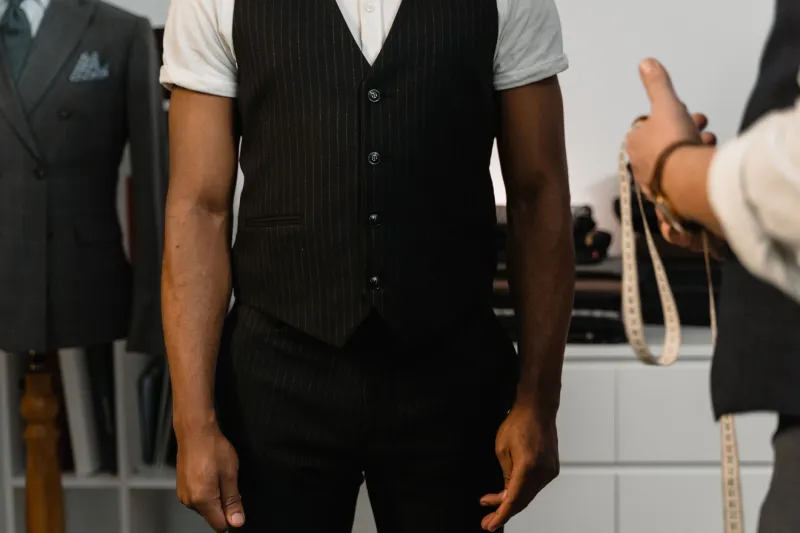
There is a particular kind of confidence that cannot be purchased off a rack. It arrives only when a garment has been made to answer — precisely and without compromise — to the dimensions of a single body. Among the most serious collectors of luxury fashion, this understanding is not a revelation. It is a founding principle.
The acquisition of an exceptional piece, whether a structured Brioni blazer, a hand-finished Loro Piana overcoat, or a silk gown from a storied European atelier, represents only the first chapter of a longer, more deliberate story. The second chapter belongs to the tailor.
The Alteration as Authorship
In the world of elite collecting, fit is not a matter of convenience. It is a form of authorship. When a collector brings a newly acquired garment to a trusted alterations specialist, they are not correcting a deficiency — they are completing a design. The original maker establishes the foundation: the fabric, the construction, the proportion, the intention. The collector and their chosen artisan then refine that foundation until it speaks in a wholly personal voice.
This distinction matters. A jacket that fits well reads as expensive. A jacket that fits perfectly reads as bespoke — and the difference, to a trained eye, is immediately apparent. Serious collectors understand that this invisible signature, this evidence of individual calibration, is what separates a wardrobe of acquisitions from a wardrobe of statements.
The most accomplished collectors in the United States often maintain long-standing relationships with a small number of highly skilled tailors, frequently in cities known for their craft traditions: New York's Garment District, the bespoke ateliers of Chicago's Gold Coast, or the quiet, appointment-only workrooms that serve a discreet clientele in Los Angeles and San Francisco. These relationships are cultivated over years, sometimes decades, and they represent a form of investment as significant as the garments themselves.
What the Right Alteration Actually Changes
The practical dimensions of expert alteration extend well beyond aesthetics, though the aesthetic transformation alone can be profound. A jacket with the correct sleeve pitch moves with the body rather than against it. A trouser with a properly adjusted rise eliminates the visual interruption that disrupts an otherwise immaculate line. A coat with a slightly repositioned button stance can shift the entire silhouette from merely handsome to architecturally precise.
Beyond appearance, fit fundamentally changes the experience of wearing a piece. Garments that move correctly feel different — lighter, more responsive, less effortful. This is not a small matter for collectors who wear their acquisitions rather than preserve them solely for archival purposes. A piece that fits with exactitude is a piece that will be reached for repeatedly, that will earn its place in active rotation rather than languishing in storage.
There is also the question of longevity. Garments that fit well are subject to less stress at their seams and stress points, meaning that a properly altered piece will often outlast a comparable piece worn as-purchased. For collectors who think in terms of decades — who consider the eventual fate of their wardrobes with the same seriousness that an art collector might consider conservation — this structural argument for alteration carries considerable weight.
The Resale Dimension
Perhaps less intuitively, expert alteration can have a meaningful impact on resale value — provided it is executed with restraint and precision. The luxury resale market in the United States has matured considerably in recent years, and sophisticated buyers at the top of that market are increasingly attuned to the quality of a garment's construction history.
An alteration performed by a master tailor using appropriate materials and techniques leaves a piece structurally sound and, in many cases, more desirable than its original state. A poorly executed alteration, by contrast, can permanently diminish a piece's value and its appeal to future collectors. This is why the choice of artisan is never incidental. The tailor is not a service provider in the conventional sense; they are a collaborator whose skill becomes embedded in the piece itself.
Collectors who document their alteration history — noting the artisan, the date, and the specific modifications made — are beginning to find that this provenance information adds a layer of narrative value to significant pieces. In the same way that exhibition history enhances the story of a work of fine art, a record of thoughtful, skilled alteration speaks to a collector's seriousness and the care with which a garment has been stewarded.
Finding and Keeping the Right Artisan
For collectors who have not yet established a relationship with a master alterations specialist, the process of finding one warrants the same deliberate approach applied to any significant acquisition. Referrals from other serious collectors remain the most reliable path. Private shopping consultants and the client relations teams at top-tier American boutiques are also valuable sources of introduction.
The initial consultation with a new tailor is itself a form of evaluation. A skilled specialist will ask questions about how a piece will be worn, what movements it must accommodate, and what aesthetic outcome the collector is seeking. They will handle the garment with visible respect for its construction. They will offer an honest assessment of what is achievable and what is not — because some alterations, however desirable in theory, cannot be made without compromising the integrity of the original.
This candor is a mark of genuine expertise. The collector who encounters it should recognize it as such, and respond accordingly.
The Invisible Made Visible
There is something quietly radical about the philosophy that fit represents the final, essential layer of luxury. In a market saturated with visible signals — logos, heritage narratives, scarcity-driven pricing — the idea that the most significant refinement is one that most observers will never consciously register runs counter to the prevailing logic of conspicuous consumption.
And yet this is precisely the point. For collectors who have moved beyond acquisition as performance, the invisible signature of perfect fit is among the most satisfying expressions of genuine taste. It requires knowledge, patience, investment, and access to skilled artisans who are themselves becoming increasingly rare.
It is, in other words, exactly the kind of refinement that Secret Collection was built to honor — curated, exclusive, and entirely one's own.