Where the Collection Lives: Rethinking Storage as a Curatorial Statement
There is a moment, familiar to any serious collector, when the wardrobe outgrows its original purpose. What began as a practical arrangement of clothing and accessories gradually becomes something more complex — a physical record of taste, judgment, and accumulated knowledge. At that threshold, the question is no longer simply where things are kept. It becomes how they are kept, and what that choice communicates about the collector's relationship to the objects themselves.
Across the United States, a quiet but significant shift is taking place among the most discerning fashion collectors. Investment-grade storage — once the exclusive province of museum conservators and auction house specialists — is entering the private domain with increasing sophistication. Climate-controlled vaults, archival tissue systems, custom-built display cabinetry, and digitized inventory platforms are no longer curiosities. They are becoming the infrastructure of a serious collection.
The Conservation Imperative
At its most fundamental level, thoughtful storage is an act of respect. Luxury textiles — silk, cashmere, hand-embroidered couture, leather of exceptional quality — are sensitive materials. Heat, humidity, light exposure, and improper folding can compromise integrity over a surprisingly short period. A garment that cost thousands of dollars and represents hours of skilled craftsmanship deserves an environment engineered to protect it.
Conservation specialists who work with private clients recommend maintaining storage spaces at temperatures between 60 and 70 degrees Fahrenheit, with relative humidity kept between 45 and 55 percent. Ultraviolet light filtering is essential for any collection exposed to natural light, even indirectly. These are not arbitrary specifications. They are drawn from the same principles that govern the preservation of museum textiles and fine art on paper — because the underlying science is identical.
What distinguishes the collector's approach from mere fastidiousness is the understanding that preservation is not passive. It is an ongoing, active commitment that shapes every decision about where a piece lives, how it is supported, and how frequently it is accessed.
Architecture as Curation
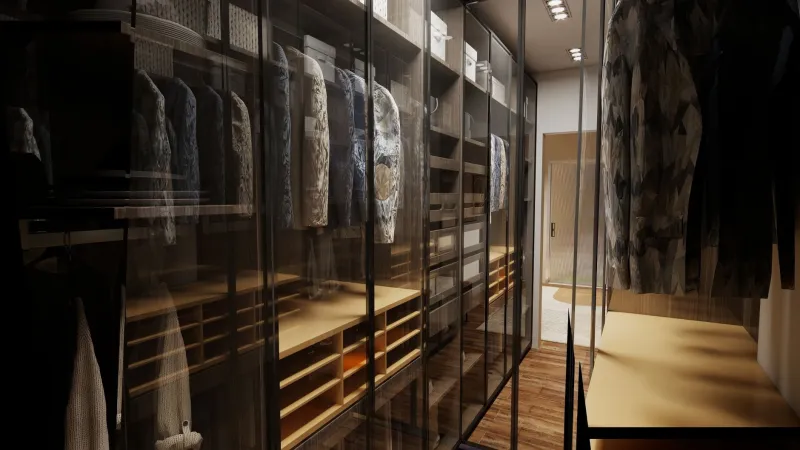
Beyond environmental controls, the physical architecture of a storage space reflects and reinforces curatorial intent. The most thoughtful collectors design their closets and vaults the way a curator designs an exhibition — with deliberate consideration of sequencing, visibility, and the relationship between objects.
Some collectors organize by provenance: garments from a particular house, period, or designer grouped together to tell a coherent story. Others arrange by material or construction technique, placing hand-tailored pieces alongside one another to draw attention to the spectrum of craft traditions they represent. Still others prefer a chromatic or tonal organization that creates visual harmony across the collection as a whole.
The underlying principle, regardless of system, is intentionality. A collection arranged thoughtfully communicates something to anyone who encounters it — and, more importantly, to the collector who moves through it daily. The act of selecting a garment becomes a form of engagement rather than a simple retrieval. The storage space becomes a site of ongoing aesthetic dialogue.
Bespoke closet designers in cities like New York, Los Angeles, and Chicago are increasingly working alongside collectors to create environments that balance archival integrity with accessibility. Dedicated hanging sections with padded, cedar-wrapped bars accommodate structured outerwear and couture. Flat drawers lined with acid-free tissue preserve folded knitwear and delicate accessories. Glazed display cases allow exceptional pieces — a rare vintage Halston, a limited-edition Hermès object — to be appreciated visually without risk of handling damage.
The Digital Dimension
A collection of any genuine depth eventually demands a parallel system of documentation. Photographs, provenance records, purchase receipts, condition reports, and care notes form an archive within the archive — a record that serves both practical and intellectual purposes.
Digital inventory platforms designed specifically for high-value collections allow collectors to search, sort, and cross-reference their holdings with precision. Some systems integrate directly with smart storage environments, logging when a piece was last accessed and flagging items that may require professional cleaning or re-housing. Others function more simply as visual catalogs, providing a searchable record that proves invaluable for insurance purposes and estate planning.
The discipline required to maintain such documentation is itself a form of curatorial practice. It demands that the collector know each piece — its history, its condition, its place within the larger narrative of the collection. That knowledge, accumulated over time, is what distinguishes a serious collection from an expensive wardrobe.
Accessibility and the Living Collection
One tension worth addressing directly: the risk that an emphasis on preservation can tip into paralysis. A collection that is never worn, never touched, never brought into contact with the life it was made to accompany has been reduced to something closer to inventory than to a living practice.
The finest storage solutions resolve this tension rather than intensify it. When a garment is properly supported, correctly housed, and easily retrievable, wearing it becomes a pleasure rather than an anxiety. The collector who knows that her 1990s Comme des Garçons jacket is stored correctly — padded shoulders protected, lining supported, humidity controlled — can remove it, wear it, return it, and do so repeatedly without diminishing the piece. Proper care enables engagement rather than preventing it.
This is the vault mindset at its most mature: not hoarding, but stewardship. The collection is held in trust, not imprisoned. It is available to be worn, studied, lent, and eventually passed on — but always on terms that honor the integrity of the objects themselves.
The Storage Space as Signature
For collectors who have thought deeply about what their holdings represent, the space that houses them eventually becomes a kind of signature — as distinctive and revealing as the collection itself. A visitor who enters a well-designed collection environment understands immediately that they are in the presence of someone who takes these objects seriously.
That seriousness is not about ostentation. Some of the most impressive private collections in the United States are housed in relatively modest rooms, distinguished not by their square footage but by the care and intelligence with which every element has been considered. The right lighting. The right temperature. The right system of organization. The right balance between preservation and access.
At Secret Collection, we believe that the curatorial impulse does not end at acquisition. It extends through every dimension of how a collection is held, maintained, and inhabited. The vault — whether literal or figurative — is not separate from the collection. It is part of it.