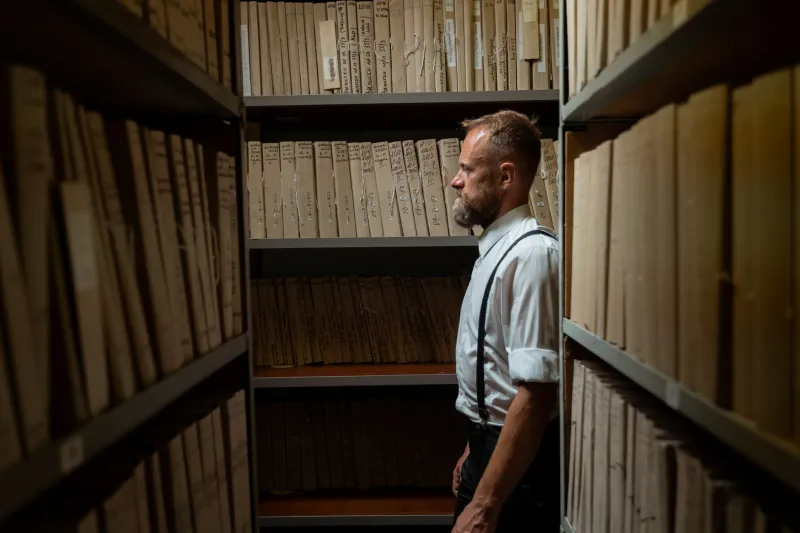
Archive Intelligence: How Serious Collectors Are Turning Past Seasons Into Lasting Wealth

There is a particular kind of collector who does not linger near the front row of new arrivals. She is not uninterested in the contemporary—she simply understands that the most advantageous acquisitions are rarely found at full retail price during a season's first flush. Instead, she turns her attention to the archive: to runway pieces from five, ten, or fifteen years past that the broader market has yet to fully reassess. In doing so, she is not indulging in nostalgia. She is executing a strategy.
The quiet migration toward archive and vintage haute couture is one of the defining shifts in American luxury collecting over the past decade. What was once the province of theatrical costume hunters and devoted fashion historians has evolved into a sophisticated investment discipline, one that demands rigorous market knowledge, an acute understanding of cultural timing, and the patience to hold a position while the wider conversation catches up.
The Market Logic of the Archive
At its most fundamental level, the appeal of archive fashion rests on a principle familiar to any serious collector of fine art or rare wine: scarcity compounds over time. A Balenciaga evening coat from the Ghesquière era, a Galliano-period Dior bias-cut gown, or a McQueen tailored jacket from a defining early collection exists in finite quantity. Unlike contemporary pieces—which, however limited their initial run, remain subject to reissue, revival, and curatorial homage—the originals cannot be recreated. The cultural moment that produced them has passed, and with it, the conditions for their authenticity.
What drives appreciation, however, is not scarcity alone. The archive market is governed by a complex interplay of cultural reassessment, critical scholarship, and generational taste. A designer whose influence was underappreciated during their commercial peak may be radically revalued when a new generation of designers openly acknowledges that debt. Conversely, a house whose runway spectacles dominated press coverage in a given decade may find that very ubiquity working against long-term collectibility—familiarity, in the archive market, can be as damaging as obscurity.
What Separates a Collectible from a Curiosity
Experienced dealers and collectors are largely in agreement on the criteria that distinguish a piece with genuine appreciation potential from one that will remain a charming but static acquisition.
Narrative specificity is perhaps the most decisive factor. Pieces that can be anchored to a singular, documented moment—a show that shifted the conversation, a collection that marked a creative turning point, a garment worn by a figure of cultural significance—carry a story that compounds in value as the surrounding context deepens. A dress from a collection that critics dismissed at the time but that subsequent scholarship has recognized as visionary is precisely the kind of asset that rewards the patient and the well-read.
Construction integrity matters enormously. The archive market is unforgiving of pieces that have not held their physical form. Haute couture and high-end ready-to-wear from the most exacting houses were built to endure, but condition remains a primary determinant of value. Collectors who invest in proper storage—acid-free archival materials, climate-controlled environments, professional conservation when necessary—protect not only the garment but the investment thesis attached to it.
Provenance and documentation have become increasingly central to the market's pricing logic. A piece accompanied by its original receipt, atelier tags, photographs of its runway appearance, or correspondence connecting it to a notable original owner commands a meaningful premium over an otherwise identical garment without that paper trail. The serious collector treats documentation not as a bureaucratic afterthought but as a core component of acquisition strategy.
Reading the Cycles
One of the more counterintuitive insights shared by veteran archive dealers is that the optimal acquisition window for a given era is often the period of maximum market indifference—typically ten to twenty years after the original season. The immediate post-season window is distorted by residual retail pricing. The nostalgia premium, which arrives roughly thirty years out, inflates values in ways that make entry costly. The decade in between, when a collection is neither fashionably current nor romantically distant, is frequently the moment of greatest opportunity.
Applying this logic to the current landscape, several periods stand out as worthy of close attention. The mid-to-late 2000s output of certain American and European houses—collections that were commercially successful but have not yet received the critical reassessment they are beginning to attract—represents a particularly interesting stratum for collectors willing to do the research. Similarly, the early digital era of fashion communication produced a generation of shows that were extensively documented online but whose physical output has not yet been systematically collected, creating pockets of relative undervaluation.
Building a Framework for Identification
For collectors approaching the archive market with genuine investment intent, a structured methodology is essential. The following principles offer a starting point.
First, study the critical literature with the same rigor applied to financial due diligence. Fashion scholarship, retrospective exhibition catalogs, and the growing body of academic work on twentieth and twenty-first century dress history provide the intellectual scaffolding for identifying which collections are being reassessed and which designers are entering a period of renewed scholarly interest.
Second, cultivate relationships with reputable archive dealers and specialist auction specialists. The most significant archive pieces rarely surface through general resale channels. They move through networks built on trust and expertise, and access to those networks is itself a competitive advantage.
Third, resist the gravitational pull of the obvious. The most celebrated pieces from the most celebrated houses are already priced to reflect their status. The more interesting opportunity frequently lies in the secondary figures of a defining era, the underappreciated collections of celebrated designers, or the houses whose geographic or cultural distance from the dominant fashion capitals has allowed their work to remain undervalued relative to its quality.
Finally, develop a clear thesis for each acquisition. The collector who can articulate precisely why a given piece will be more valued in fifteen years than it is today—grounding that argument in cultural trajectory, construction quality, provenance, and scarcity—is far better positioned than one who relies on instinct alone.
The Patience Premium
Perhaps the most important quality the archive market demands is one that the contemporary retail environment is not designed to cultivate: the willingness to wait. The collector who acquires with a fifteen-year horizon and the discipline to hold through periods of market indifference is the one who ultimately captures the full value of a well-reasoned thesis.
This is, at its core, the same disposition that distinguishes the finest collections from the merely expensive ones. It is not the accumulation of what is celebrated today, but the identification of what will be essential tomorrow—pursued with intelligence, patience, and an eye trained on the long arc of fashion history rather than the fleeting urgency of the present season.